
WELCOME BONUS 300%
UP TO €2000 + 100
FREE SPINS
UP TO €2000 + 100
FREE SPINS
Home → Blackjack
Blackjack at Reddice: Variants, Rules and Payouts
Splitting costs double bet: plan budget
Splitting a hand in Blackjack requires doubling the initial bet, effectively doubling the financial commitment for that round. For instance, if a player splits a pair of Aces, their initial wager of €10 becomes €20 for the two new hands. This means the player must account for this increased expenditure, especially when considering the €5,000 maximum bet limit on tables like Quantum Blackjack Plus Live or Infinite Blackjack.
The decision to split has a direct impact on the player's bankroll management, as each split hand incurs an additional bet equal to the original. Games such as Blackjack Party or Infinite Blackjack offer a broad betting range from €1 to €5,000, making the doubled bet significant at higher stakes. Therefore, a budget for potential splits is crucial for sustained play.
Considering the potential for multiple splits, the cost can escalate rapidly. If a player starts with a €100 bet and splits twice, the total bet for that turn could reach €300 or more, depending on the game's rules on resplitting. This necessitates careful budgeting to avoid depleting funds prematurely, especially with side bets available in games like Infinite Blackjack.
What Peek Means with a Dealer Ace
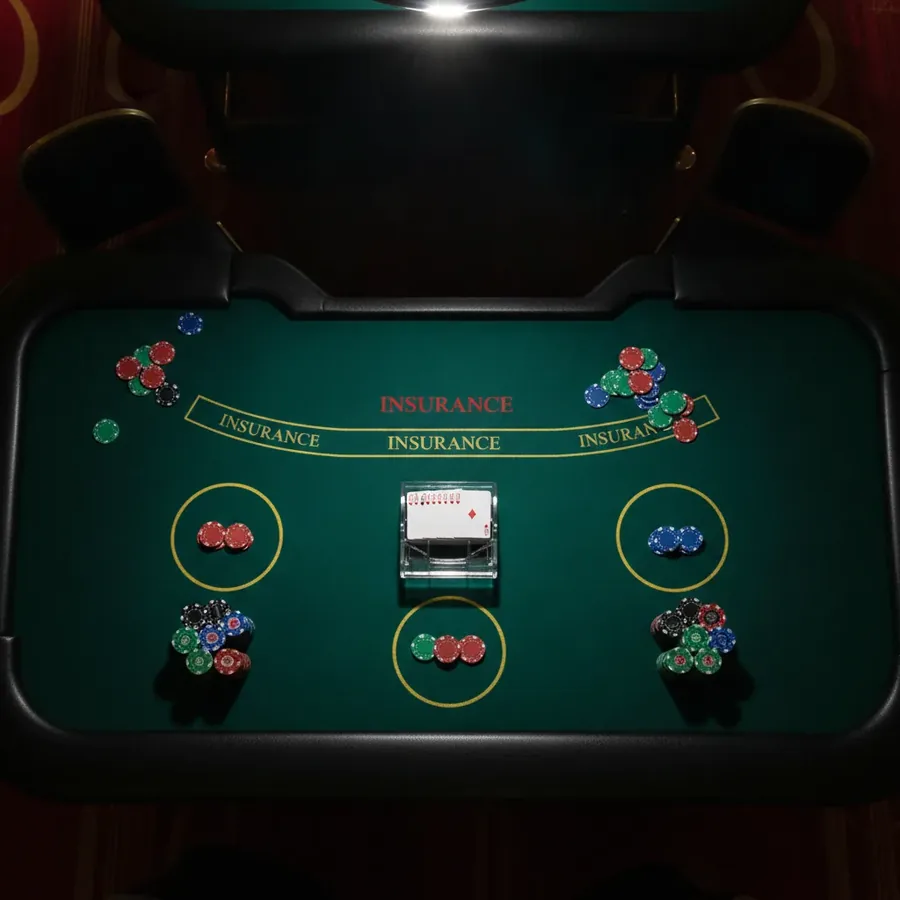
When the dealer's upcard is an Ace, a 'peek' procedure may occur, allowing the dealer to check for Blackjack before players commit further to their hands. This is a common rule in many Blackjack variants, designed to protect players from losing their entire bet if the dealer has Blackjack. The 'Blackjack Insurance' side bet, which pays 2:1, is specifically offered when the dealer shows an Ace, though basic strategy advises against it.
The concept of 'Insurance' in Blackjack, paying 2:1, is a side bet taken when the dealer's visible card is an Ace. This wager essentially covers the possibility of the dealer achieving a Blackjack. For example, on a €10 bet, an insurance bet of €5 would pay out €10 if the dealer has Blackjack. However, the RTP for Blackjack Insurance is as low as 92.53%, making it a disadvantageous wager long-term.
If the dealer does not have Blackjack after the peek, the insurance bet loses, and play continues as normal. This rule significantly influences player decisions, particularly regarding the 'Blackjack Auszahlung 6:5 statt 3:2' variant, where a dealer Blackjack would mean losing the main bet but potentially profiting from insurance. The standard rule in 'Blackjack 6 Decks, S17, DAS, DOA, Auszahlung 3:2, Basisstrategie' also incorporates a dealer peek.
What doesn't count towards turnover at 10 percent?
Table games, including various Blackjack variants, typically contribute only 10% towards fulfilling bonus wagering requirements. This means for every €100 wagered on a table game, only €10 is counted towards the total turnover needed to release bonus funds. For example, playing 'Blackjack Auszahlung 6:5 statt 3:2' would only contribute €10 to a €100 wagered amount.
This 10% contribution rate significantly extends the time and amount required to clear bonus funds compared to slots, which contribute 100%. Therefore, a €2,000 welcome bonus with a wagering requirement of 40x would necessitate €80,000 in turnover if playing slots exclusively. However, if only table games were played, the required turnover would be €800,000.
Certain side bets in Blackjack, such as 'Blackjack Insurance' with its 92.53% RTP, might also fall under the reduced contribution category, or potentially be excluded entirely. Always verify individual game contributions.
Even Money only possible with Dealer Ace
The 'Even Money' option in Blackjack is a special payout offered when a player has a Blackjack and the dealer's upcard is an Ace. This option allows the player to receive an immediate payout equal to their original bet, effectively securing a 1:1 payout instead of the standard 3:2 for a Blackjack. This is a crucial distinction from the 'Insurance' bet, which is a separate wager.
This 'Even Money' payout is exclusively available when the dealer displays an Ace as their hole card, signifying a potential for Blackjack. Games like 'Blackjack 6 Decks, S17, DAS, DOA, Auszahlung 3:2' offer this option, providing players with a guaranteed win when they hold a natural Blackjack and the dealer shows an Ace. The standard Blackjack payout is 3:2, so taking Even Money means foregoing a potential extra €5 on a €10 bet.
The 'Blackjack Auszahlung 6:5 statt 3:2' variant significantly alters the value proposition of 'Even Money'. While the standard Blackjack payout is reduced to 6:5, the 'Even Money' option still provides a 1:1 payout. This makes the decision to take 'Even Money' more critical in such games, as the difference between 1:1 and 6:5 is less pronounced than between 1:1 and 3:2.
Bonus Lost Due to 10 Percent Contribution
A significant hurdle in clearing bonus funds is the 10% contribution rate from table games, which includes most Blackjack variants. The welcome bonus of 300% up to €2,000 means a player could receive up to €2,000 in bonus cash. If the wagering requirement is 40x the bonus amount, this translates to €80,000 in turnover needed.
When playing Blackjack, only 10% of each wager counts towards this €80,000 turnover. Therefore, a player would need to wager a total of €800,000 on Blackjack to satisfy the bonus conditions. This is a substantial amount compared to playing slots, where €80,000 in wagers would suffice due to their 100% contribution.
The potential to lose the bonus is high if players primarily engage with table games like 'Blackjack Party' or 'Quantum Blackjack Plus Live' without understanding the contribution rates. For example, wagering €100 on Blackjack only contributes €10 towards the turnover. This slow progress can lead to the bonus expiring before the wagering requirements are met, especially given the high turnover demands.
Blackjack variants at a glance
| Variant | Payout | House edge | Rule | Bet range |
|---|---|---|---|---|
| Blackjack Ein Deck, klassische Regeln, 3:2 | 99.85% | 0.15% | Weniger Decks = niedrigerer Vorteil; ein Deck gibt ca. −0.48 Prozentpunkte gegenüber 8 Decks. Oft durch 6:5 Auszahlung kompensiert. | Blackjack 3:2, Gewinn 1:1 |
| Blackjack Insurance / Versicherung (6–8 Decks) | 92.53% | 7.47% | Separate Nebenwette bis 50% der Hauptwette, wenn der Dealer ein Ass hat. Basisstrategie schreibt IMMER Ablehnung vor (außer Karten zählen bei True Count ≥ +3). Bei einem Deck Vorteil ≈ 5.88% | Insurance 2:1 |
| Blackjack Auszahlung 6:5 statt 3:2 (6 Decks) | 98.15% | 1.85% | Ersatz von 3:2 durch 6:5 fügt exakt +1.39 Prozentpunkte zum Vorteil des Casinos hinzu – stärker als jede andere Regeländerung. Bei $10 Einsatz zahlt Blackjack $12 statt $15. | Blackjack 6:5, Gewinn 1:1 |
| Blackjack 6 Decks, S17, DAS, DOA, Auszahlung 3:2, Basisstrategie | 99.54% | 0.46% | Dealer steht auf Soft 17; Verdopplung auf jeder Zweierkarte; Verdopplung nach Split erlaubt; keine Aufgabe. Basisstrategie ist für diesen Wert zwingend | Blackjack 3:2, normaler Gewinn 1:1, Insurance 2:1 |
| Blackjack Surrender (Late Surrender) – Regel-Effekt | n.a. (Regel-Modifikator) | −0.08 Prozentpunkte | Spieler gibt Hand nach Dealer-Blackjack-Prüfung auf, verliert die Hälfte des Einsatzes. Verbessert RTP um ca. 0.08 Prozentpunkte. Early Surrender ist wesentlich wertvoller (bis −0.6 Prozentpunkte), aber extrem selten. | Rückzahlung 50% des Einsatzes |
| Blackjack Liberal Vegas Strip (liberale Regeln, 3:2) | 99.72% | 0.28% | Günstigste Regelkombination: S17 + DAS + Resplit + Late Surrender. Standardabweichung 1,15 | Blackjack 3:2, Gewinn 1:1 |
Surrender vs Playing Out on 16 vs 10
The Blackjack Surrender rule allows a player to forfeit half their bet after the dealer checks for blackjack, effectively reducing the house edge by approximately 0.08 percent points. This option is particularly valuable when holding a hard 16 against a dealer's 10, as it mitigates potential losses.
While less common, Early Surrender offers a more significant RTP improvement, potentially up to 0.6 percent points. In contrast, Late Surrender, as seen in some Reddice variants, permits the player to give up their hand only after the dealer has inspected their cards for a blackjack.
Choosing to play out a hand of 16 against a dealer's 10 without surrender is a riskier proposition. The RTP for Blackjack Ein Deck with classic rules and 3:2 payouts is 99.85%, but this specific scenario without surrender carries a higher inherent risk compared to utilizing the surrender option.
Soft Hand and Hard Hand Practically Distinguished
A soft hand in blackjack contains an Ace counted as 11, meaning it can be played flexibly without busting. For example, a soft 17 consists of an Ace and a 6. The house edge for Blackjack Liberal Vegas Strip, featuring liberal rules, is a competitive 0.28%.
Conversely, a hard hand has no Ace or an Ace counted as 1, making it prone to busting if further cards are drawn. A hard 17 might be a 10 and a 7, or a 9, 5, and 3. The RTP for Blackjack 6 Decks, S17, DAS, DOA, with a 3:2 payout, stands at 99.54%.
Understanding the distinction is crucial for optimal strategy. For instance, the Blackjack Split / Double / H17 rule modifiers show that a dealer hitting a soft 17 (H17) increases the house edge by 0.22 percent points, a factor to consider during gameplay.
Insurance vs Even Money on Own Blackjack
Blackjack Insurance is a side bet offered when the dealer's upcard is an Ace, allowing players to wager up to 50% of their main bet that the dealer has blackjack. This bet pays 2:1, but has a high house advantage of 7.47% for standard 6-8 deck games.
The RTP for this insurance bet, even with a single deck where the advantage drops to approximately 5.88%, is significantly lower than the main game's RTP. Standard strategy dictates always declining this bet unless card counting indicates a true count of +3 or higher.
An 'even money' payout on a player's own blackjack is a different scenario, typically offered when the dealer shows an Ace and the player has blackjack. This pays 1:1 on the original bet, effectively securing a win without risk, unlike the insurance side bet.
Step-by-step Split at the Live Table
Splitting pairs in live blackjack, such as at Evolution's Blackjack Party, allows players to create two separate hands from their initial two cards if they are of the same rank. This action effectively doubles the initial bet for that round, offering potential for increased winnings.
The ability to Double After Split (DAS) further enhances strategic options, allowing a player to double down on a two-card hand that was created by splitting. This rule, present in Blackjack Liberal Vegas Strip with a 0.28% house edge, can improve the player's RTP.
Some live blackjack variants, like those found at Reddice, permit resplitting Aces (RSA), which can improve the RTP by approximately 0.08 percent points. However, it's important to note that Ace splits often have restrictions, such as being dealt only one additional card.
Clicked Too Late: Hand Is Automatically Held
In online blackjack, failing to act within the allotted time for a decision, such as hitting, standing, doubling, or splitting, results in an automatic action. This is a common feature across many platforms, including those offering variants like Blackjack Ein Deck with its high 99.85% RTP.
The specific automatic action often defaults to 'stand' or 'hit', depending on the game rules and the player's hand. For instance, if a player is presented with Blackjack Surrender and does not click the surrender button in time, their hand will be played out as normal.
This automated process ensures the game flow continues without delay, however, it can lead to suboptimal outcomes if the player intended a different action. For example, missing the opportunity to surrender a weak hand can increase the house edge, contrasting with the 0.15% edge of Blackjack Ein Deck.
Set session stop after 30 percent loss
A session stop at a 30 percent loss is a recommended safeguard. For instance, if a player deposits €100, setting this limit means play will automatically conclude once losses reach €30. This prevents larger potential deficits from occurring during a single gaming session.
This proactive measure is distinct from the casino's house edge, which represents the theoretical long-term profitability for the operator. For example, Blackjack with a 3:2 payout and standing on soft 17 has a house edge of 0.46%, a figure calculated over vast numbers of hands.
Implementing such a stop-loss parameter ensures that a player's bankroll is protected from rapid depletion, allowing for more controlled engagement with games like Blackjack Split/Double/H17, where RTP can be influenced by specific rule modifications.
What a Natural Blackjack Practically Pays Out
A natural Blackjack, achieved with the first two cards totaling 21, typically pays out at a 3:2 ratio. For example, a €10 bet on a natural Blackjack would yield a €15 payout, in addition to the original stake returned.
This payout rate is significantly more favourable than a 6:5 payout, which would only return €12 for the same €10 bet. The difference of €3 per winning natural Blackjack is substantial when considering multiple hands played over time.
While a natural Blackjack offers a superior return, other game variants, such as Blackjack with a single deck and classical rules, can boast an RTP of 99.85%, demonstrating that overall game structure also influences player returns.
Live stream with three cameras and OCR
Live Blackjack streams utilizing three cameras provide an immersive viewing experience. This setup is complemented by Optical Character Recognition (OCR) technology, which accurately reads card values and game states for seamless interface display.
For instance, Quantum Blackjack Plus Live, offered by Playtech, incorporates dynamic multipliers up to 1,000x on specific 21-point combinations, with an optimal strategy RTP of 99.57%. The advanced camera work ensures these multiplier opportunities are clearly visible.
Infinite Blackjack by Evolution, featuring unlimited player seats, also benefits from high-definition streaming. This allows players to clearly follow the action and the application of side bets like Any Pair or Bust It, enhancing engagement.
Six Card Charlie Pays Immediately with Six Cards
The 'Six Card Charlie' rule is a specific provision in some Blackjack variants where a player wins if they accumulate six cards without busting. This payout is immediate and does not rely on the dealer having a weaker hand.
While not a standard payout ratio in the same way as a natural Blackjack, achieving a Six Card Charlie provides a guaranteed win for the player. This rule can be a significant advantage, especially in games with a lower house edge.
Blackjack variants with liberal rules, such as those on the Las Vegas Strip, often feature favourable conditions, but the Six Card Charlie rule is an additional player-centric provision that directly impacts the outcome of a hand, independent of the dealer's actions.
Soft 17: Dealer Hits or Stands
The rule regarding the dealer's action on a 'Soft 17' (a hand totaling 17 with an Ace counted as 11) significantly impacts the game's house edge. When the dealer hits on Soft 17, the house advantage increases by approximately 0.22 percentage points.
Conversely, if the dealer stands on Soft 17, the house edge is reduced. For example, a Blackjack game with Dealer Stands on Soft 17 (S17), Double After Split (DAS), and Double only on first two cards (DOA) offers an RTP of 99.54% with a house edge of 0.46%.
Players should note that variations in this rule, such as Blackjack Split/Double/H17, where the dealer hits soft 17, directly modify the return to player (RTP) and the overall house advantage, making the S17 rule a critical factor in game selection.
Contact
Live - online chat
Banking









Providers












Red Dice Casino 2026